|
|
Verification of Exemption
California elects not to require verification of exemptions for the student eligibility rule. Client statement that a student is exempt from the student eligibility rule on the application, during the interview, periodic report, recertification, or during the certification period is sufficient evidence that the student is exempt from the student eligibility rule.
Only one exemption is needed to qualify a student for CalFresh. The SSBS must document all exemptions being claimed in the case record. If the student loses an exemption, the SSBS must assess whether the student meets the criteria for another exemption before taking adverse action.
Important: While the student exemption is no longer a mandatory verification, income must be verified to determine the household's income eligibility for CalFresh.
SSBSs must only require verification that a student meets an exemption from the student eligibility rule when:
- Information provided by the household is questionable; or
- A student’s physical or mental unfitness claim is not evident to the SSBS.
Note: The CalFresh Medical Certification Form (CF 887) may be used to verify an individual’s physical or mental unfitness to work when it is not evident to the SSBS.
Questionable Exemption
If an exemption is questionable, SSBS must follow the previous guidance for verifying student eligibility exemptions, including those listed in this section. Below are examples of questionable information for purposes of establishing an exemption from the student eligibility rule. This list is not intended to be exhaustive.
|
Criteria Exempting the Student |
Examples of Questionable Information |
|
Employed for an average of 20 hours per week or a total of 80 hours per month |
The student does not have monthly gross income totaling the state minimum wage (or federal minimum wage if self-employed) multiplied by 80 hours, or wage stubs provided for income verification show the student working less than the required threshold |
|
Parental control for a child under age 6 |
Another parent has claimed this exemption as the primary person responsible for the care of the child |
|
Parental control for a child under age 12 without adequate childcare |
Another parent has claimed this exemption as the primary person responsible for the care of the child, or the child has adequate childcare |
|
Single parent responsible for a child under age 12 |
There are two of the child’s natural, adoptive, or step-parents in the same CalFresh household as the child |
|
Part of a CFET program |
The County does not have a record of the student participating in CFET |
|
Program to increase employability |
The program the student mentions is not on the LPIE listed on the CDSS website |
|
Receipt of TANF-funded benefits like CalGrant A/B |
The student provides a complete list of financial aid awarded as part of income verification, and Cal Grant A or B is not listed. |
|
Approved for work study and anticipates working (only applicable after the Temporary Eligible for Work Study exemption ends |
The student states they do not expect to accept a work study job offer |
|
Temporary: Eligible for work study |
The student provides an income verification document that indicates the student is not eligible for work study |
The SSBS must document in the case record what exemption is being claimed. If a student’s statement that they meet an exemption from the student eligibility rule is questionable and verification is requested, the reason must be adequately documented in the case record as to why the information was deemed questionable, and that verification was requested.
The following are suggested verifications for specific programs if questionable:
Approved for State or Federal Work Study
This exemption is partially based on a student being approved for work study for the current term, as defined by the institution of higher education. Acceptable verification of approval for work study may include a work study award letter from financial aid, but it is not limited to this.
Receipt of Cal Grant A or B
Verification of receipt of a Cal Grant A or B may include but is not limited to, a copy of a student’s California Aid Report, which is an award letter provided by the California Student Aid Commission and/or a printout of award confirmation from a student’s college or university web grants account.
- For purposes of verifying whether a Cal Grant A or B recipient meets two of the three TANF Cal Grant eligibility requirements outlined, including currently unmarried and 25 years of age or younger, the SSBS may reference existing case information.
- To verify whether the student meets the third requirement, parental and/or student income of $50,000 a year or less, counties should reference the student’s California Aid Report (provided by the student), which includes information regarding parental and/or student income at the time the student was deemed eligible for the Cal Grant A or B.
Local Programs that Increase Employability (LPIE) Approved by the State
AB 396, signed into law on October 4, 2021, requires all CCC and CSU campus-based programs that meet LPIE requirements to submit an application to the CDSS on or before September 1, 2022, and requests UC programs to do the same. SB 609, signed into law on October 6, 2021, requires CDSS to include Adult Education and CTE programs in the List of Approved LPIEs.
Verification of LPIE
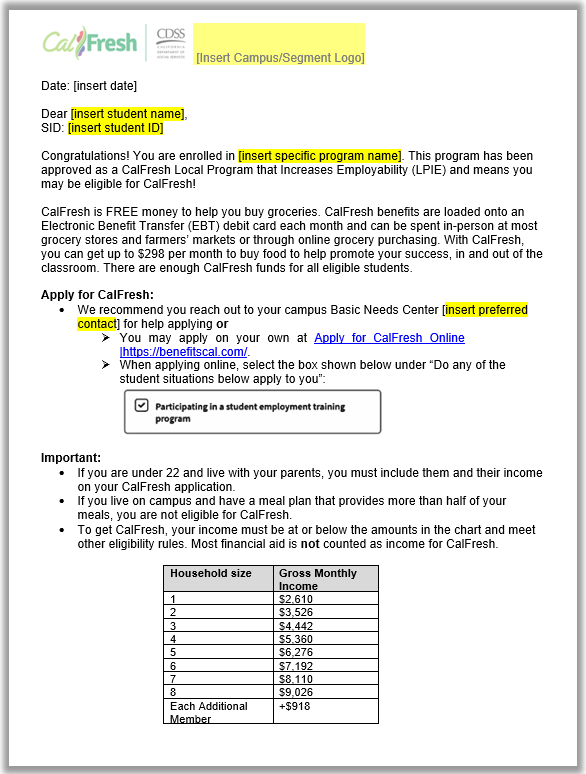
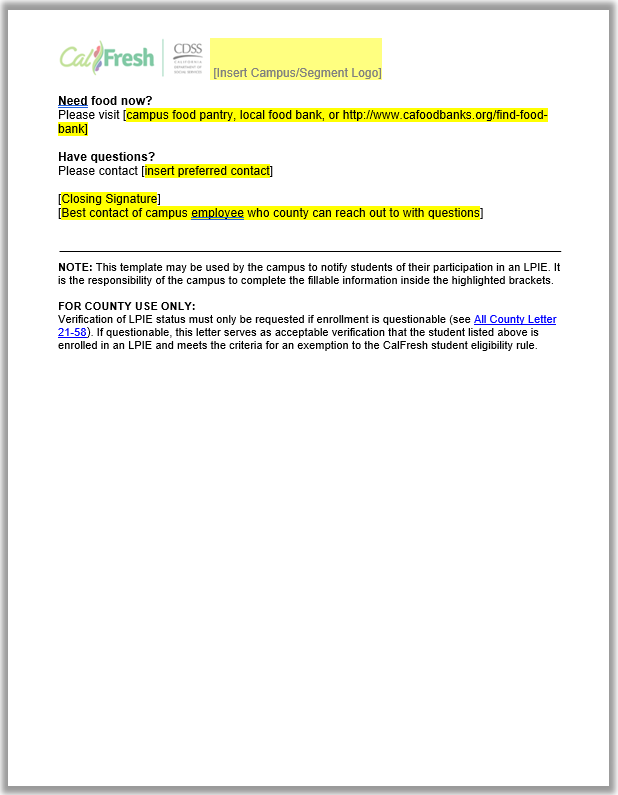
If a student states, verbally or in writing, that they are enrolled in one of the programs listed on the List of Approved LPIEs, that is sufficient information for the County to exempt the student unless it is questionable. If the information provided by a student is questionable, acceptable verification can include but is not limited to a transcript, an email from an instructor, or verbal affirmation from a campus official. Additionally, targeted outreach emails from campuses to LPIE enrollees are acceptable verification. Typically, students enrolled in an LPIE will be notified by their campus that they meet the criteria for an exemption to the student eligibility rule. If a program does not appear on the Approved LPIE List, the county must explore if the student is enrolled in another LPIE or meets the criteria for another exemption before determining the student to be ineligible.
All associate and bachelor’s degree programs at CCC, CSU, and UC campuses are approved statewide, as General Programs on the List of Approved LPIEs. SSBS are no longer required to confirm that an associate or bachelor’s degree at a public institution of higher education appear on the Lists of approved LPIEs to grant the exemption.
LPIE Notification Letter
Below is a sample copy of the LPIE notification letter provided by individual higher education institutions.
Related Topics