Intentional Program Violation (IPV)
This subsection outlines the processes when Intentional Program Violation (IPV) referrals are received from the Special Investigation Unit (SIU).
| Step | Who | Actions |
| 1 | SIU |
|
| 2 | Clerical |
|
| 3 | Eligibility Examiner (EE) |
REMINDER: IPVs must be processed within 45 days from the date SIU sent the referral IEVS to comply with State guidelines. |
| 4 | Supervisor |
|
| 5 | Clerical |
|
| 6 | Supervisor |
|
Intentional Program Violators (IPV) Online Automation System
The state and federal mandates require the California Department of Social Services (CDSS) Fraud Bureau to maintain a database of individuals whose CalWORKs and/or CalFresh Benefits are suspended as a result of an IPV. CDSS IPV System uploads CalFresh program IPV suspension information to the National CalFresh database, known as the electronic Disqualified Recipient System (eDARS).
Prior to the automated system, counties reported IPV actions to the CDSS’s Fraud Bureau via a manual input form. Fraud Bureau staff would then transcribe these reports into an online database and upload appropriate information to eDRS. The online database was available for review by the county’s staff as needed.
The CDSS Fraud Bureau developed an IPV Online Automation System that allows counties to directly input and review their own county’s CalWORKs and/or CalFresh IPV data. The IPV Online Automation System will not allow staff to add or delete an IPV entry, but will allow them to update information. It also allows county staff to update records related to cases that transfer to their county from another county. The recording of IPV information is mandated by California Welfare and Institutions Code (W & I Code) Section 11486.
Inquiries
EEs in the IEVS Unit are responsible for processing IPVs. The Eligibility Workers should contact the IEVS Supervisors via Email when the Disqualification Data tab in CalWIN’s View IEVS Applicant Prior Aid Data window is enabled, to report changes, or with inquiries on the following:
- Sanctions - If an applicant or recipient has a CalWORKs and/or CalFresh current or prior IPV sanction, and whether the sanction period has been served in its entirety.
- ICT - Report and have the case record updated, which was transferred to Santa Clara County from another county.
|
If... |
Then... |
|
Disqualification Data tab is enabled. |
The EW must review the record details, contact the IEVS Supervisors via e-mail, and Cc the IEVS Supervisor with the following Information:
Information from the Disqualification Data tab: Disqualification Program/State/Months/Penalty Start Date and the Origin County. |
|
Disqualification Data Tab is disabled. |
The individual currently does NOT have an IPV record, and EW staff can proceed to process the application. |
Forms
Two forms must be completed for adding/deleting a designated person:
- The “Intentional Program Violation (IPV) Deletion Request Form” (DPA 488 [6/08]) is ONLY to be used by the IEVS Eligibility Examiner staff.
- The “Intentional Program Violation (IPV) Online Automation System Request For Adding/Deleting A County User” (DPA 489 [6/08]) is to be used to add ONLY designated staff and to delete a user.
Reference Guide
An IEVS Intentional Program Violation (IPV) Online Automation System Reference Guide has been created. It is located in the S drive under ASB IEVS. The Reference Guide includes the following information:
- Overview of the IPV Online Reporting System
- County User Instructions
- IPV Deletion Request Form DPA 488 (6/08)
- IPV Online Automation System Request for Adding/Deleting A County User DPA 489 (6/08), and
- Frequently Asked Questions and System Help Information.
CalWORKs or CalFresh Disqualification Abstract
The information in this section identifies the individual with the listed SSN who has been disqualified from cash aid or CalFresh in other counties. The information is 1 month to 12 months old. EWs must contact the county where the disqualification began and continue with the disqualification if the client has months remaining on the period. The information in this section of the abstract will include:
|
SECTION |
DESCRIPTION |
|
TYPE |
The program from which the individual was disqualified. It will be AFDC or CalFresh. CalWORKs is included under the AFDC code. |
|
STATE |
The state where the individual was disqualified. It will be a 2-digit number based on the post office methodology. |
|
FIPS CODE |
Does not apply at this time. |
|
SSN |
The Social Security Number is associated with the disqualification. |
|
CLIENT NAME |
The first and last names of the individual are based on the SSN listed. |
|
DOB |
The date of birth, MM/DD/YY, for the individual is based on the SSN listed. |
|
DISQUALIFICATION NUMBER |
The number assigned to this disqualification. |
|
LENGTH OF MONTHS |
The number of months the individual is to be disqualified. |
|
DECISION DATE |
The date of the decision to disqualify the individual. |
|
START DATE OF PENALTY |
The date the penalty started. |
|
PROGRAM INFORMATION |
The contact name of the person to be contacted regarding the disqualification. |
|
PHONE |
The phone number for the contact person. |
|
CONTACT ORGANIZATION |
The agency for the contact person. |
|
USES AKAS |
Y for Yes and N for No. |
SB 360 California Welfare and Institutions Code (WIC) Section 10980
(ACL 18-22)
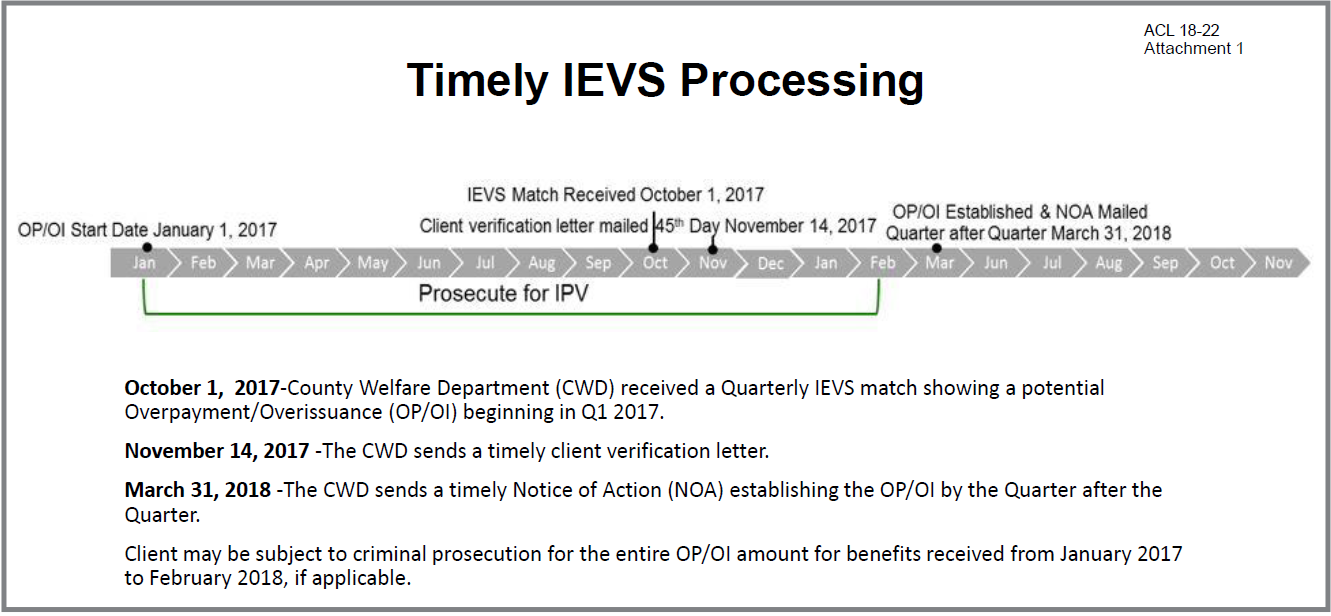
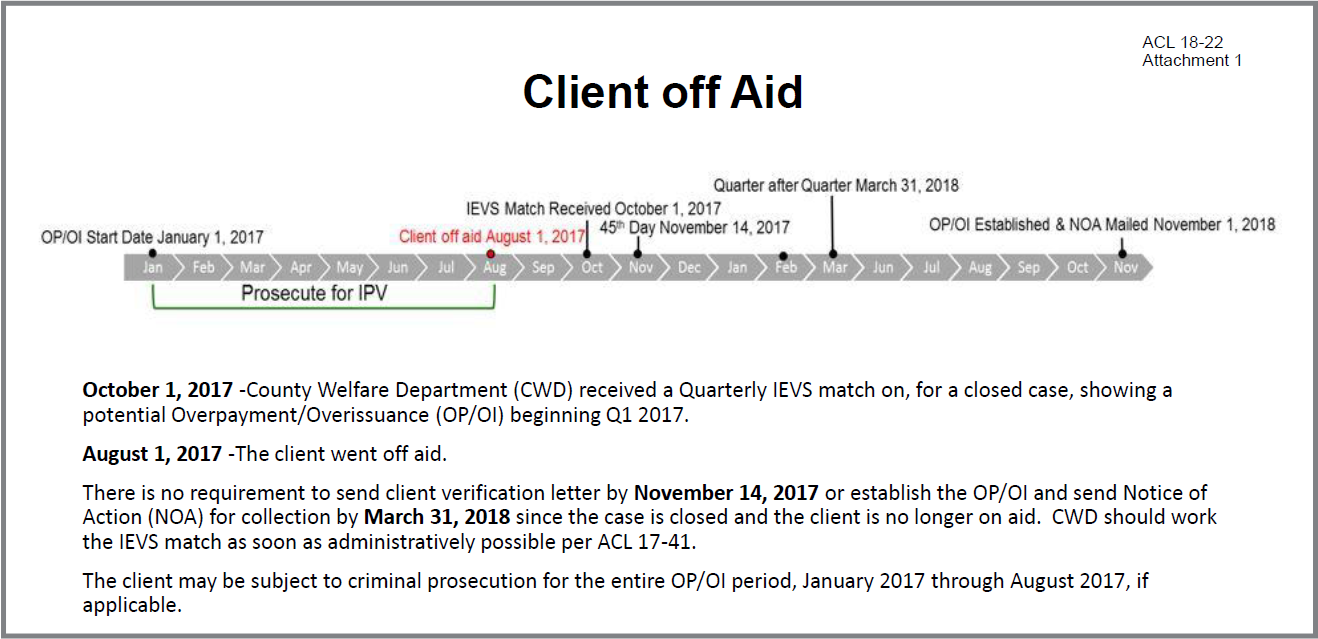
Under Senate Bill (SB) 360, criminal prosecution is not permitted for any portion of an overpayment or overissuance that results from a county's delay in processing IEVS matches or failure to issue a proper notice. The protection also extends to subsequent IEVS data matches that reveal the same unreported income. The timeframes for criminal prosecution apply to the first IEVS data match received by the county.
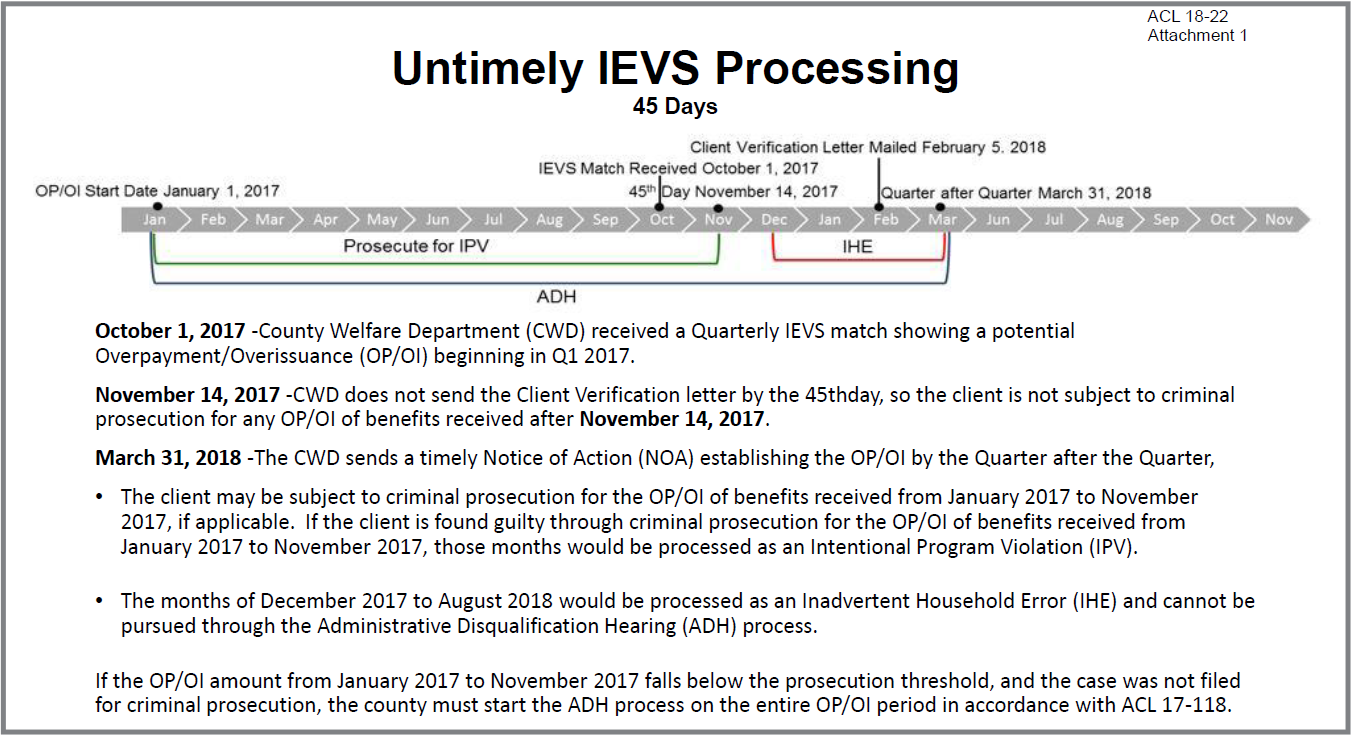
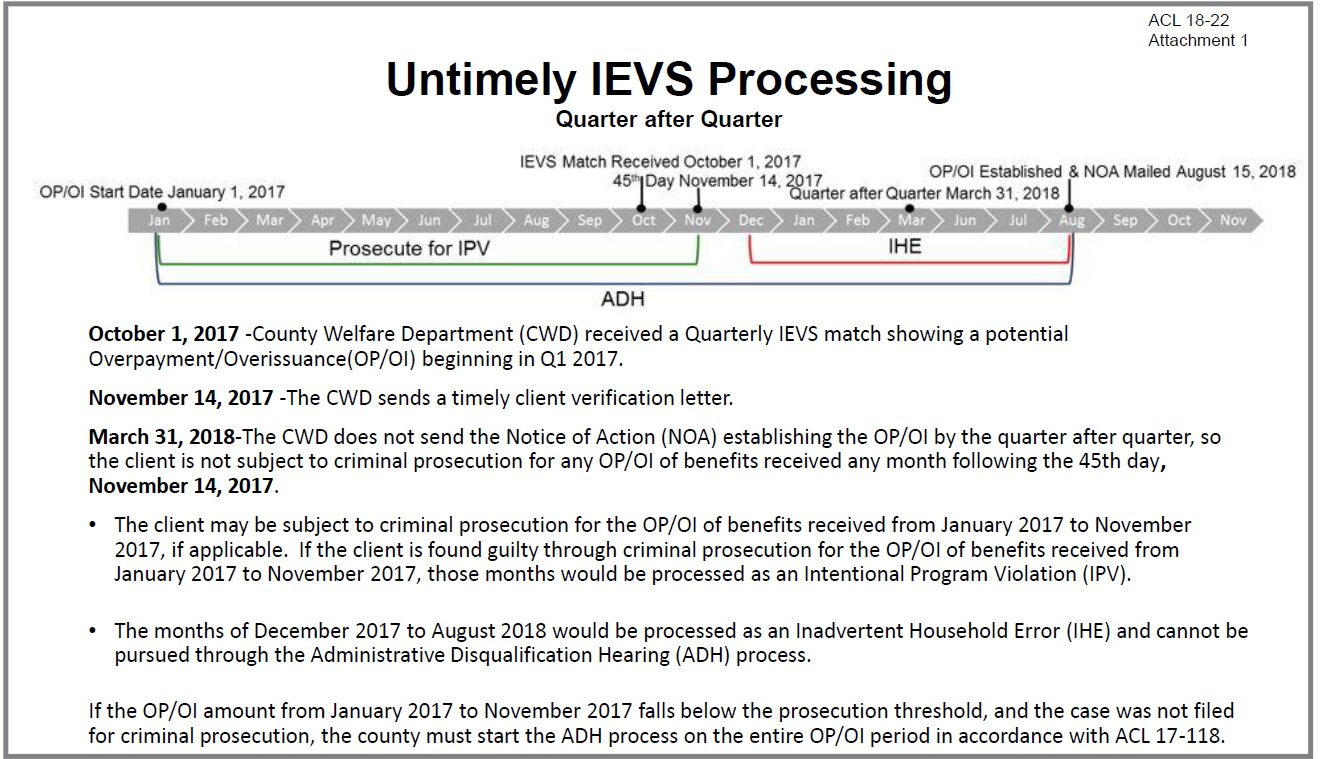
The CW/CF recipient cannot be subjected to criminal prosecution for any OP/OI of benefits received in any month after the 45th day if the County fails to provide the client with a:
- Client verification letter by the 45th day from receipt of an IEVS data match, indicating a potential discrepancy, and requesting the client to confirm the information on the match; and/or
- Timely and adequate notice for the establishment and collection of the OP/OI by the quarter following the quarter of the IEVS that indicates a potential discrepancy.
If the county fails to meet either of these deadlines, the individual cannot be criminally prosecuted for any OP/OI related to benefits issued after the 45th day.
Important: If the individual is found to have committed an IPV through the criminal prosecution process, the months in which the County received the IEVS data match information would be considered an Inadvertent Household Error (IHE) and cannot be pursued through the Administrative Disqualification Hearings (ADH) process.
Examples: